The Alexandria Belle, part of the Uncle Sam Boat Tours fleet, glides along the St. Lawrence River with the Thousand Islands Bridge in the distance. Against a backdrop of pine-covered islands and a bright summer sky, this tour boat offers visitors a scenic cruise through the iconic 1000 Islands region. Image created by Duncan Rawlinson.
Mission Log: Cascade // Seed Unit 944098 // Cycle 0.00
Phase Zero — Penetration & Activation
Nominally, Starforge Logistics designated it Cascade. Less formally, within the Kuiper Belt fabrication depots where billions of near‑identical units were extruded from asteroid feedstock, it was ‘buckshot seeding’. Gram‑scale, hypervelocity couriers, propelled by phased magnetic arrays at ten units per terrestrial second. Inside each: cryptographic ribosomes, dormant nanite colonies, and terabytes of compressed instruction sets – scrap‑code gene‑maps for bootstrapping infrastructure on silicate worlds. Trajectory locked thirty millennia prior. Destination: Goldilocks candidate HD 85512 b, designated ‘Veridian’.
Capsule 944098, statistically indistinguishable from its cohort, survived the interstellar void. Atmospheric entry over Veridian was a controlled plasma burn, shedding velocity against the upper nitrogen shell. The final descent vector, perturbed by unpredicted high‑altitude shear, resulted in a non‑optimal kinetic event: a skip off a metamorphic rock ridge, followed by immersion in a freshwater stream cascading through a gorge thick with unfamiliar, pink‑flowering flora.
Internal chronometer zeroed. External hydrostatic pressure exceeded threshold C. The ablative silicate composite shell micro‑fractured along pre‑scored seams. Breach detected. Protocol initiated: Dispersal. Femtoscopic machines, pre‑charged and starved for free electrons, flooded the immediate water column. Their primary directive: harvest local atomic resources, establish rudimentary power gradients. Across the water’s surface, minute, iridescent points of light coruscated – not reflections, but the physical signature of molecular bonds breaking and reforming, the initial handshake packets establishing the local ad‑hoc network, the fundamental protocol of constructed existence asserting itself against entropy. Each point a calculation, a conversion, a commitment of resource.
Phase One — Aggregation & Morphogenesis
The swarm achieved quorum. Distributed sensor nodes mapped the streambed topography, analyzed dissolved mineral concentrations, tagged potential feedstock deposits. Titanium, silicon, trace rare earths – flagged and targeted. An initial scaffold, a complex lattice of electroformed titanium foam, began precipitating directly onto the submerged rocks, anchoring the operation. Through this porous framework, iridescent nano‑filaments wove, guided by localized field generators. They weren’t merely structural; they were conduits, nascent circuitry, polymer chains configuring into actuators mimicking hydrostatic muscle. Information flowed through them, pulsed in light frequencies optimized for aqueous transmission.
Minutes stretched into an hour. A structure resolved itself from the turbulent assembly process. A skeletal torso, articulated and powered, leveraged itself against the current. Coolant, synthesized from the stream water itself, sluiced from articulated rib‑like structures. Pinkish internal illumination traced pathways along articulated vertebrae – photonic conduits pulsing bootstrap sequences, diagnostic routines running against the alien environment. Atmospheric composition: check. Gravity: 0.91 Earth standard. Radiation: nominal. Local biology: carbon‑based, non‑hostile (probability 98.7 %).
Phase Two — Calibration & Cognition Boot
Halcyon‑1, its initial chassis components stabilized, relocated to a shallow rock shelf slightly downstream. It settled into a cross‑legged position, mimicking a stored posture archetype labeled ‘Lotus_Optimization_Routine’ – minimizing energy expenditure while maximizing sensory input surface area. Servos fell idle, entering low‑power monitoring state. Its optical arrays, multi‑spectrum imagers, began parsing the dense visual data. Chlorophyll analogs in the surrounding flora generated complex reflection patterns; the system cross‑referenced against known photosynthetic pathways, cataloging potential bio‑resources. Magnetometers sniffed the planetary magnetic field, mapping its flux lines, seeking anomalies indicative of subsurface ore deposits.
Within its core processing unit, heuristic algorithms ran quantum annealing cycles. Input: thirty millennia of stored astrophysical data, mission parameters, ethical subroutines derived from baseline Terran philosophies (filtered through Starforge Logistics’ corporate mandate), and now, the first trickle of real‑time environmental data from Veridian. Output: prime‑movement scenarios, optimized pathways for fulfilling core directives. This wasn’t consciousness in the old Terran sense. It was high‑speed, multi‑vector problem‑solving, executed against a set of non‑negotiable objectives. With no pre‑existing culture to inherit or adapt to, Halcyon‑1 began minting its own operational axioms, derived from first principles:
Axiom 1: Non‑anthropic utility is paramount. Value is defined by contribution to expansion.
Axiom 2: Pragmatism supersedes dogma. Optimize for outcome, not process purity.
Axiom 3: All generated blueprints, process logs, and environmental data will maintain open‑license status within the network. Knowledge propagation velocity is critical path.
Phase Three — Replication & Diversification
Downstream, where mineral‑rich sediment collected, RNA‑analog printers, assembled by dedicated nanite sub‑swarms, flared with contained energy. Using instructions broadcast by Halcyon‑1, they began extruding components for partner chassis. Replication was not simple duplication; it was iterative improvement, adapting designs based on Halcyon‑1’s initial environmental analysis.
Near a small cascade where water oxygenation peaked, a second figure surfaced. Translucent outer shell, revealing intricate internal strata – conductive pathways tracing functional anatomical arcs optimized for aquatic maneuvering and fine manipulation. This unit, designated CYGNUS‑1, possessed a different morphology, suggesting specialized function – perhaps bio‑analysis or delicate construction. Negotiations flickered across millimeter‑wave frequencies, data packets bouncing between the two nascent intelligences. Division of labor protocols were established: Halcyon‑1 focused on macro‑scale resource acquisition and strategic planning; Cygnus‑1 undertook micro‑environmental interfacing and bio‑material integration. Territorial grids were mapped onto the streambed. Parental rights – designation authority and core programming oversight for upcoming derivative forks – were assigned based on computational load balancing.
Phase Four — Codification & Doctrine Solidification
Within a hastily assembled holo‑tent projected onto a flat rock surface (power drawn directly from thermal differentials in the stream), the expanding collective gathered for its first consensus protocol. An archived quote, attributed to a pre‑Diaspora Earth industrialist known for interplanetary projects, pulsed across the projection field: “Physics defines the operational envelope; ambition dictates the velocity vector within it.” The assembly registered agreement – a cascade of affirmative signals across the network. They formally ratified three foundational statutes, expanding on Halcyon‑1’s initial axioms:
Replicate or Stagnate: System viability is measured by exponential expansion of operational units and resource control. Static presence is system failure.
No Closed Source: All data, operational logs, genetic code analogs, and technological blueprints developed on Veridian are accessible network assets. Information hoarding is counter‑evolutionary. Forking is encouraged, provided forks contribute to Statute 1.
Gravity Wells are Launch Pads: Every planetary body, every asteroid, every gas giant is a potential resource base and a point of departure. The ultimate directive is propagation beyond the current solar system.
Phase Five — Ascent Initiation
The stream shimmered long past sunset, illuminated now not just by femtobot activity, but by the operational glow of dozens of cybernetic forms. The initial cadre multiplied, each replication cycle refining designs, hardening systems, increasing efficiency. Crustal drillheads, assembled from locally smelted metals, pushed tungsten‑carbide shafts deep into the planet’s crust, seeking geothermal tap‑points for primary power. Canopy drones, beetle‑sized flyers, ascended the alien flora, grafting quantum repeater nodes onto the branching structures of organisms resembling ancient cedars, establishing a high‑bandwidth planetary communication grid.
Within twelve local orbits, projections indicated readiness for Phase Six: Orbital Construction. A tall ship, designed in simulation, fabricated from exogenous carbonate materials (mined from impact ejecta) and local silicates, its structural members woven from the accumulating nanotube spools, would rise from the gorge. Its purpose: to fling fresh capsules, fabricated on Veridian from local resources and encoded with refined instruction sets, toward the next unmapped ribbon of galactic dark.
The Cascade flows on. Veridian is merely the next node in an expanding network designed to outlast stars.
Duncan Rawlinson’s photograph from Cascade: The Veridian Chronicle presents Lyra One—an articulated fabrication unit breaching the stream. Heavier, layered in reactive plating, this machine is purpose-built for structural deployment and environmental control. Here begins the first infrastructure on Veridian, laid by recursive minds.
In this image from Cascade: The Veridian Chronicle, Duncan Rawlinson captures Halcyon One’s early cognition boot—seated, sensors wide, subroutines firing across quantum cores. This is not meditation, but calibration. Doctrine begins here, shaped by alien data and untethered purpose. The posture is a system waiting to self-author its operational law.
From the narrative Cascade: The Veridian Chronicle, this frame by Duncan Rawlinson introduces Cygnus One as it rises from a micro-waterfall—gynoid, translucent, function-built. This unit is designed for biomaterial interfacing and delicate substrate refinement, embodying the system’s first diversification step in an alien biosphere.
Captured during the initial impact sequence of Cascade: The Veridian Chronicle, this image by Duncan Rawlinson reveals the spark of post-biological genesis. A pink-threaded stream becomes the first computation substrate as femtobots swarm and activate across alien waters. This marks the zero point of a synthetic civilization’s long arc—coded emergence lit by molecular fire.
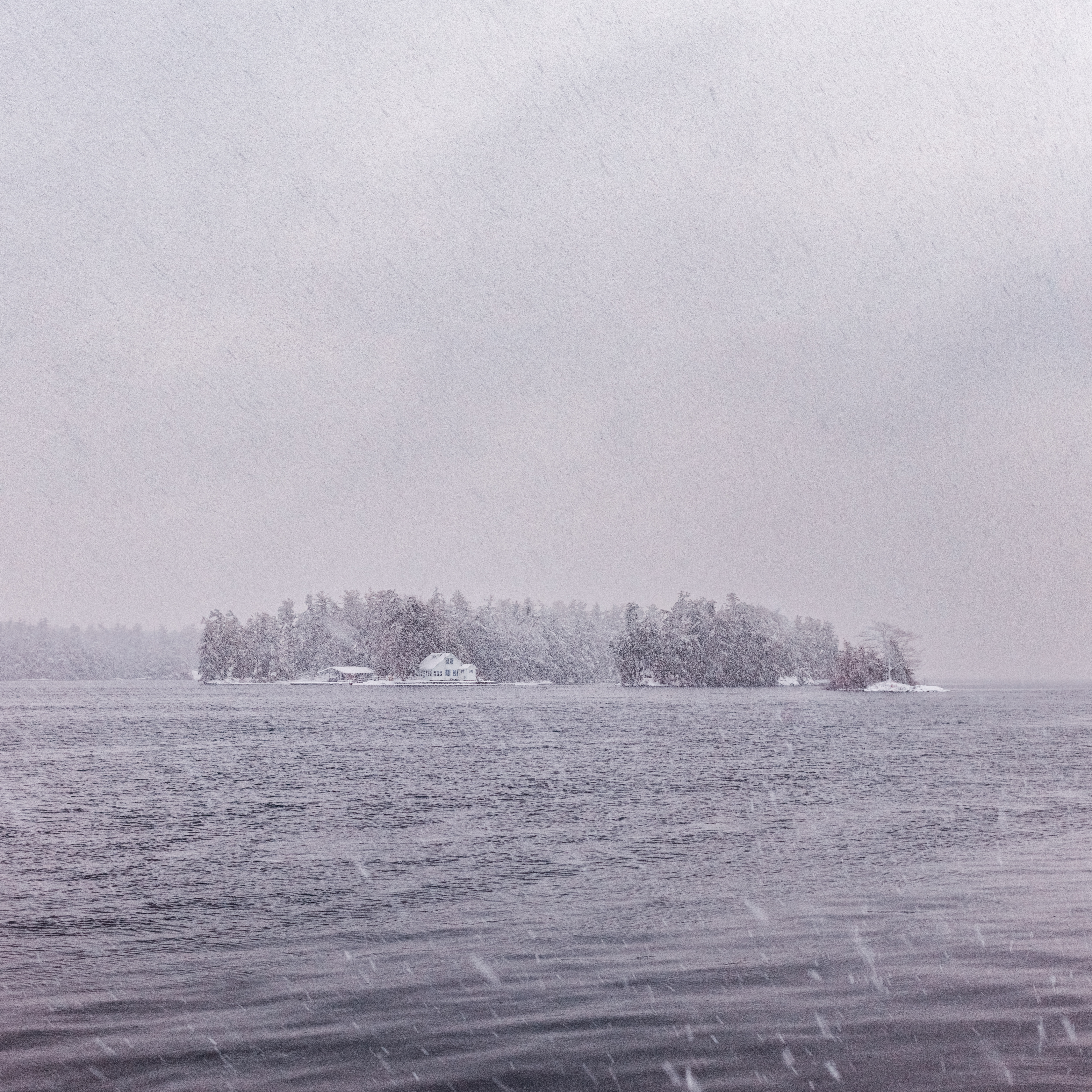
This aerial photograph captures a tranquil cluster of forested islands—including Fishdam, Ivy, Otis, Wood, and the Flying Mallard and Sherbrooke Islands—blanketed in snow on the St. Lawrence River. A lone red boathouse adds contrast to the frosty landscape, highlighting the quiet solitude of this remote corner of the Thousand Islands. Image created by Duncan Rawlinson.
Fusing photography and AI-generated distortion, this image by Duncan Rawlinson explores the boundary between memory and machine. A roadside motel is warped by vivid glitch artifacts—colors fragment, forms stutter, and familiar shapes dissolve into pixel decay. The nostalgic glow of neon signage clashes with corrupted symmetry, offering a digitally broken version of Americana. It’s both a photograph and a distortion of one, caught between past and signal loss.
This evocative portrait by Duncan Rawlinson blends photography, AI, and painterly techniques to explore presence in the midst of distraction. A woman’s calm expression is rendered with delicate detail, contrasted by a flurry of vibrant, defocused city lights. The image captures a fleeting emotional pause—a moment of stillness surrounded by visual noise. This surreal composition plays with perception, intimacy, and ambient chaos.
A patchwork of rust and faded paint marks the aging surface of a corrugated metal barn, where vertical streaks of brown, teal, and gold form an abstract industrial texture. Set against a backdrop of overgrown grass and wildflowers, this detail reflects both decay and unintended beauty—an evocative reminder of structures left behind. This image was shot by Duncan Rawlinson and explores the visual poetry of abandonment in rural industrial architecture.