
-
DSC05062

-
DSC05060

-
DSC05054

-
DSC05052

-
DSC05050

-
2006, Brought to you by you

Image by David McGlynn.Jon Pareles has an interesting article about ‘ugc‘ in 2006.
-
Community in the 21st century
We are moving to a world in which in the twenty-first century the most important activities that produce occur not in factories, and not by individual initiative, but in communities held together by software.
Eben Moglen (professor of law and general counsel for the Free Software Foundation) gave an interesting speech at the Plone conference. Plone is an open source content management system like Drupal… The talk addresses free software and community in the 21st century. (It runs 65 minutes with a transcript here)
-
New York Times Magazine 6th Annual Year in Ideas
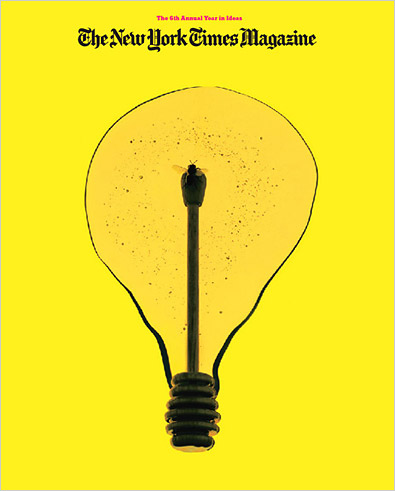
This month, as in the past five Decembers, the magazine looks back on the passing year from a distinctive vantage point: that of ideas. Our editors and writers have located the peaks and valleys of ingenuity — the human cognitive faculty deployed with intentions good and bad, purposes serious and silly, consequences momentous and morbid. The resulting intellectual mountain range extends across a wide territory. Now it’s yours for the traversing in a compendium of 74 ideas arranged from A to Z.
http://nytimes.com/indexes/2006/12/10/magazine/index.html
To bypass registration go here:
http://www.bugmenot.com/view/www.nytimes.com- The Aerotropolis
- Air-Index Impressionism
- The Ambient Walkman
- The Ballot That Is Also a Lottery Ticket
- The Beer-Gut Flask
- Bicycle Helmets Put You at Risk
- Big Urbanism
- The Boomerang Drone
- Cohabitation Is Bad for Women’s Health
- The Comb That Listens
- Creative Shrinkage
- Digital Maoism
- The Diplomat-Parking-Violation Corruption Index
- The Drivable One-Man Blimp
- The E. Coli Wipe
- Empty-Stomach Intelligence
- Energy-Harvesting Floors
- The Eyes of Honesty
- The Fashion Czar
- For-Profit Philanthropy
- The Gyroball
- The Hidden-Fee Economy
- Homophily
- Human-Chimp Hybrids
- The Humane Flophouse
- Hyperopia
- Indie Sitcoms
- Jujitsu Advertising
- The Lady Macbeth Effect
- Literary Spam
- Low Starting Prices Lead to High Auction Sales
- Misery Chic
- Money-Circulation Science
- The Myth of ‘the Southern Strategy’
- Narcissistic Celebrities
- N.C.A.A. Psyop
- Negativity Friendships
- The New Inequality
- Olfactory Cuisine
- Paternity Confidence
- Phantom Pianists
- Psychological Neoteny
- Publication Probity
- Redefining Torture
- The Return of the Corporate State
- Reverse Graffiti
- The Robot Fielder
- Rods From God
- Sailing an Oil Tanker
- Salt That Doesn’t Stick
- Shipping Containers Explain Everything
- Smart Elevators
- The Social-Cue Reader
- Sousveillance
- Speed-Reducing Art
- Spit Art
- Sporno
- Straw That Saves Lives
- Taxing Virtual Economies
- Techno Fashion
- The Tongue Sucker
- Trash-Talk Exegesis
- Tushology
- Unscratchable Paint
- The Visage Problem
- Voting-Booth Feng Shui
- Walk-In Health Care
- Web-Based Microfinancing
- The Wheelchair Car
- Wine That Ages Instantly
- Workplace Rumors Are True
- Yodeling Is Universal
- The YouTube Referee Indictment
- The Ziggurat of Zealotry
-
How To Read Google Reader Using a Bookmark
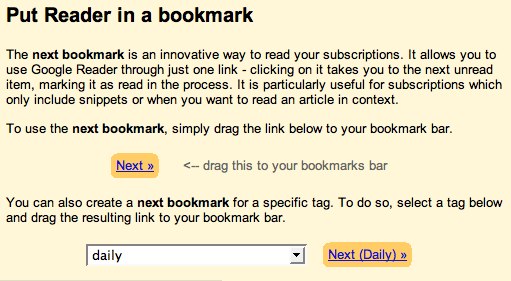
You can use Google Reader to create a bookmark for your browser that knows what you want to read and whether or not you’ve read it. I’ve done this for the sites I read most often. I click one bookmark and it takes me to the new stuff on those sites. Not the feed items but the actual sites. Click it again and it takes me to the next new item on the next site and marks the item as read. There is something to be said for actually looking at the sites themselves and not in a feed reader.
Go to your Google Reader settings -> then goodies -> choose a tag that you’ve given to some of your feeds from the drop down menu -> drag it to your menubar -> click it. -> repeat
-
little groms ruling the skatepark